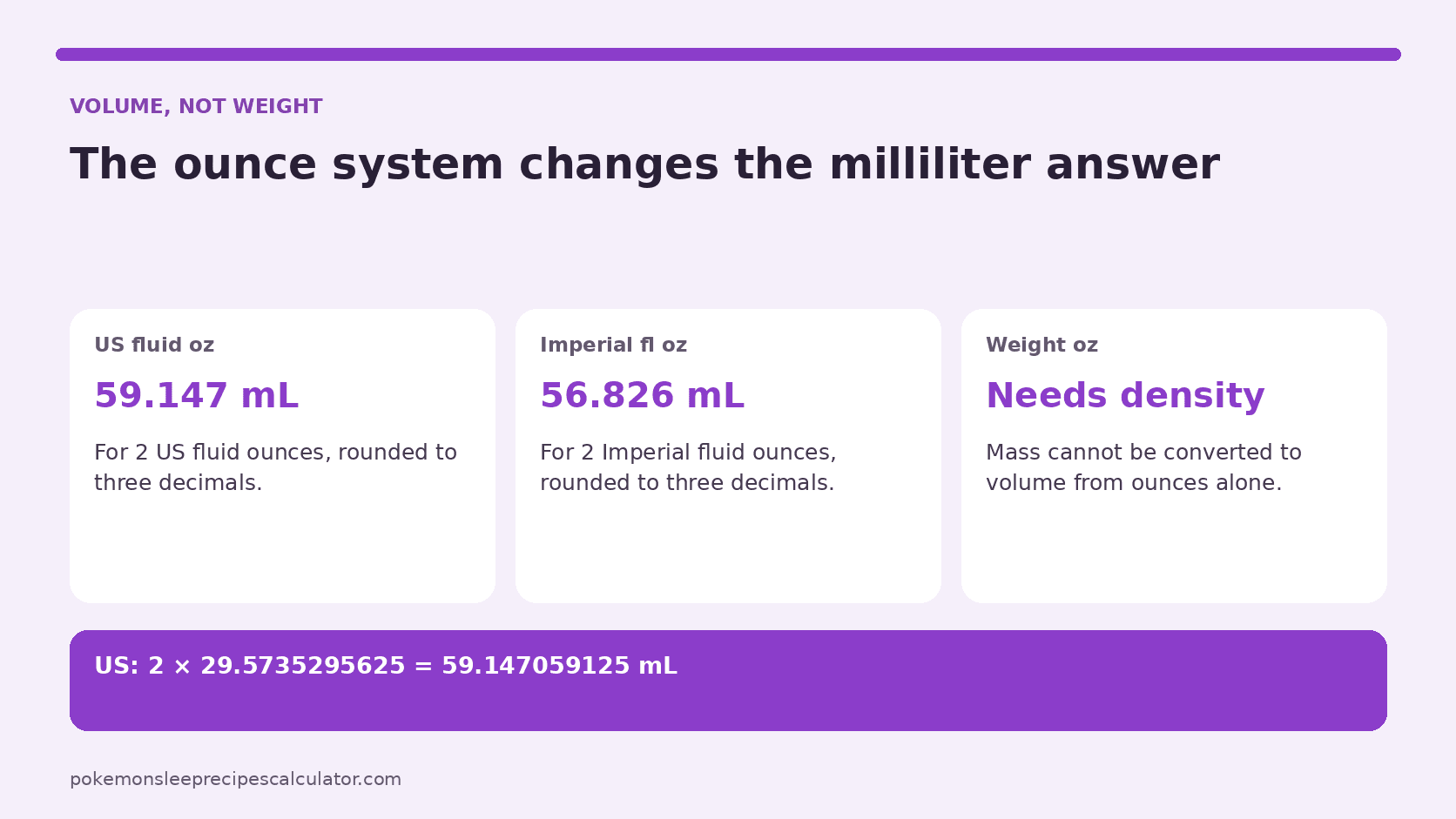
First decide whether oz means volume or weight
The abbreviation oz is used for ounces by weight, while fl oz means fluid ounces, a unit of volume. Milliliters also measure volume. That means a direct oz-to-mL conversion is only valid when the original measurement is a fluid-ounce measurement.
If a package says 2 oz by weight, there is no single correct milliliter answer. Two substances can have the same mass and occupy different volumes because their densities are different. Flour, oil, honey, and water are simple examples of materials that do not share one universal weight-to-volume conversion.
For US fluid ounces, 2 fl oz is about 59.147 mL
NIST lists the US fluid ounce as approximately 29.57 mL in its consumer conversion guidance, and its SI conversion tables give the more precise factor used by the calculator. Multiplying 2 by 29.5735295625 produces 59.147059125 mL. Use the 2 oz to mL converter to compare systems or enter a different amount.
For everyday kitchen work, rounding to 59.15 mL or 59 mL may be sufficient. For technical calculations, medicine, or repeated scaling, keep more precision until the final step so rounding does not accumulate unnecessarily.
Imperial fluid ounces are smaller
An Imperial fluid ounce is not the same size as a US fluid ounce. Two Imperial fluid ounces equal about 56.826 mL, so choosing the wrong ounce system creates a noticeable difference even at a small volume.
This matters with older British recipes, some measuring tools, and references that use Imperial units. The label or source context should determine which system you select; the converter should not guess for you.
Do not use 28.35 when converting fluid ounces
The number 28.35 is associated with an avoirdupois ounce converted to grams, which is a mass conversion. It is not the factor for converting fluid ounces to milliliters.
This is one of the most common unit mistakes because both measurements use the word ounce. A reliable converter keeps mass and volume separate and shows the factor used in the calculation.
When should you round?
Match the precision to the job. A home recipe rarely benefits from six decimal places, but a converter can preserve the precise factor internally and then display a sensible number of decimals. That is better than rounding the conversion factor first and multiplying later.
If you are scaling several measurements, keep full precision during the calculations and round the final result. If the measuring cup itself is marked only every 5 mL or 10 mL, displaying thousandths of a milliliter does not make the physical measurement more accurate.
A fast check before converting
Look for fl oz on the source measurement, identify whether it is US or Imperial, then convert. If the source only says oz and is describing package weight, stop and find either a volume measurement or the material's density.
That three-step check is more valuable than memorizing a single 2 oz answer because it prevents the same mistake at 4 oz, 8 oz, 32 oz, or any other amount.