It reads the fluid-ounce amount — the default is 2 oz, but you can enter any non-negative fluid-volume value you need.
2 oz to ml Converter
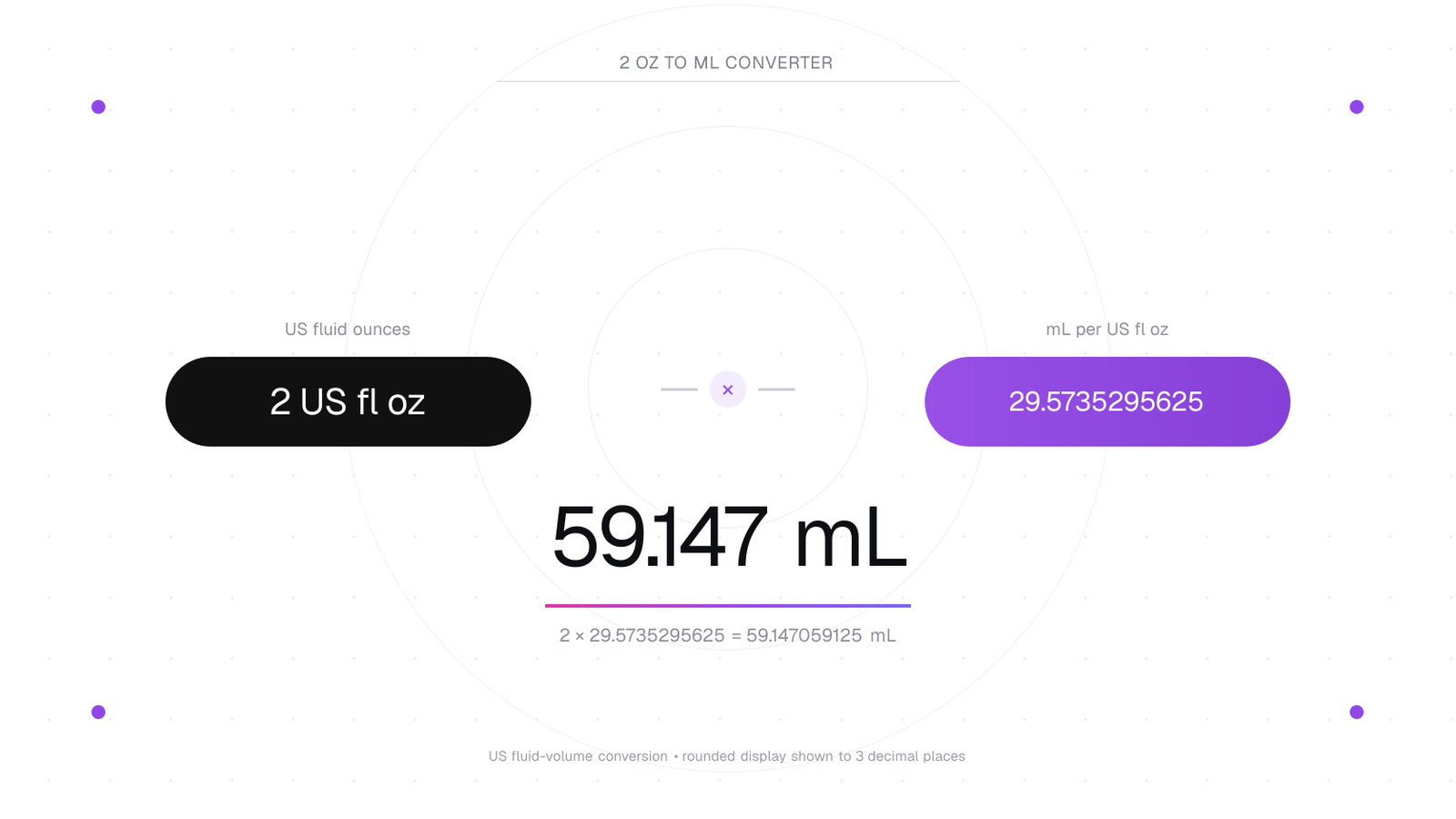
Convert fluid ounces to milliliters with a clear conversion basis. The default is 2 US fl oz, which equals 59.147 mL.
QUICK ANSWER
2 US fluid ounces = 59.147 mL
For US fluid ounces, multiply the ounce value by 29.5735295625. The calculator above keeps the conversion factor visible so you can check exactly how the result was produced. The NIST conversion tables document the unit relationships. Our US versus Imperial fluid-ounce guide explains which system to choose.
2 oz to ml | Convert Fluid Ounces to Milliliters
You have a measurement written as 2 oz, but the bottle, recipe, medicine cup, or measuring jug in front of you uses milliliters. The important detail is whether the ounce measurement means fluid ounces or ounces by weight. For a liquid-volume conversion, you need fluid ounces.
This converter is built for that exact job. Enter the fluid-ounce amount, choose the US or Imperial definition, and the tool converts the value into milliliters using the selected conversion factor. No guessing and no hidden rounding before the final result.
What Does 2 oz Equal in mL?
For US fluid ounces, 1 fl oz equals 29.5735295625 mL. Multiply that by 2 and the result is 59.147059125 mL, commonly rounded to 59.147 mL.
Imperial fluid ounces use a different definition. With that option selected, 2 Imperial fl oz = 56.826125 mL. That difference is why the calculator lets you choose the ounce system instead of assuming every “oz” label means the same thing.
The tool is designed to keep the conversion easy to check:
- Clear unit choice — US and Imperial fluid ounces stay separate
- Visible conversion factor — you can see the number used in the math
- Adjustable precision — choose how many decimal places you want to display
- Volume only — this converts fluid ounces, not ounces of weight
If a package lists only “2 oz” by weight, milliliters cannot be determined from that number alone. You would also need the material's density.
How Our 2 oz to ml Converter Works
The conversion is simple, but the unit choice matters. Here's what happens when you use the converter:
It uses the ounce system you selected — US and Imperial fluid ounces use different milliliter conversion factors.
It multiplies by the correct factor — for US fluid ounces, the calculator uses 29.5735295625 mL per fl oz.
It formats the result clearly — choose the number of decimal places you want and display the result in milliliters or liters.
You can also switch between US fluid ounces and Imperial fluid ounces, change the displayed precision, and view the conversion basis beside the result. That keeps the calculation transparent instead of showing a number with no explanation.
One important limit stays clear: this tool converts fluid ounces, which measure volume. It does not convert ounces by weight into milliliters, because a weight-to-volume conversion also depends on the substance's density.

How to Use the 2 oz to ml Converter — Step by Step
The converter is designed for a quick fluid-volume check, but each control has a purpose. Here's the cleanest way to use it:
Step 1: Enter the fluid-ounce amount. Leave it at 2 if you want the standard 2 oz conversion.
Step 2: Choose US Fluid Ounce or Imperial Fluid Ounce. The two systems do not use the same milliliter value.
Step 3: Pick how many decimal places you want to display — 2, 3, 4, or 6.
Step 4: Choose the output unit: milliliters for the usual oz-to-mL conversion, or liters for a larger-volume display.
Step 5: Click Convert. The result appears with the conversion basis and the exact milliliter value before display rounding.
That's it. If you change the amount, ounce system, precision, or output unit, the previous result clears so you can run a fresh calculation with the new settings.
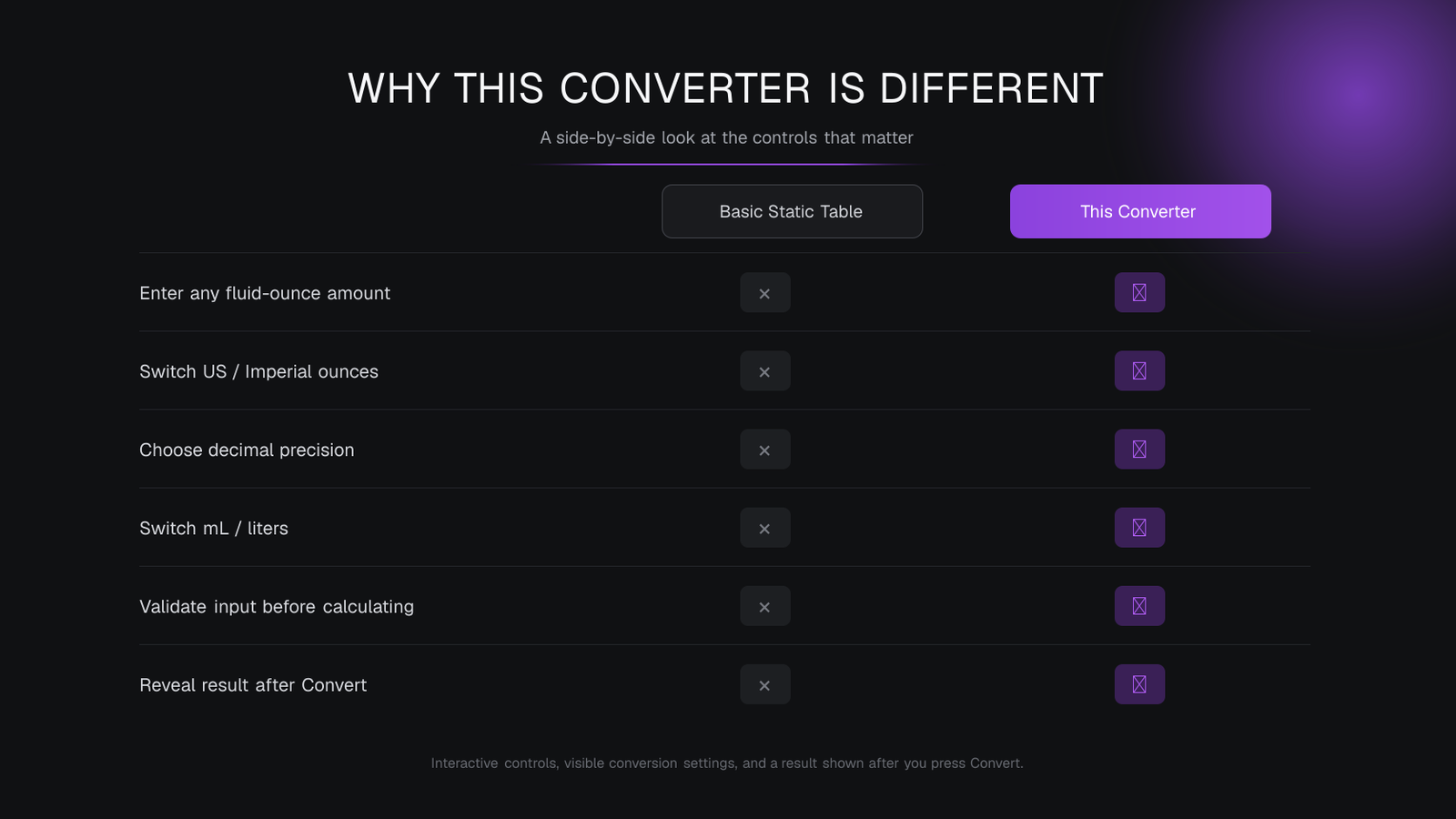
This Converter vs a Basic Static Conversion Table
A lookup table is useful when you only need one fixed value. This converter adds controls for the parts of the calculation that can actually change.
| Feature | Basic Static Table | Our 2 oz to ml Converter |
|---|---|---|
| Custom fluid-ounce amount | Usually fixed examples | ✓ Enter any non-negative amount |
| US vs Imperial fluid ounces | May show only one system | ✓ Select either system explicitly |
| Visible conversion factor | Not always shown | ✓ Displayed beside the calculation |
| Decimal precision | Fixed rounding | ✓ Choose 2, 3, 4, or 6 places |
| Output in liters | Usually separate lookup | ✓ Switch between mL and L |
| Invalid-input handling | Not applicable | ✓ Clear validation before calculating |
The conversion itself is still simple multiplication. The extra controls are there to make the unit choice, rounding, and displayed result easier to verify.
The biggest source of mistakes in an oz-to-mL conversion is usually not the multiplication itself — it is the unit. Fluid ounces measure volume, while ounces without “fl” may refer to weight. The US and Imperial fluid-ounce systems also use different milliliter values, so choosing the right definition matters before you calculate.
Tips for Converting 2 oz to mL Correctly
Getting the math right is easy once the measurement is clear. These checks help you avoid the most common problems before you use the result.
1. Check whether the label says fl oz. “2 fl oz” is a volume and can be converted directly to milliliters. “2 oz” by weight is a different measurement.
2. Choose US or Imperial before calculating. 2 US fl oz equals about 59.147 mL, while 2 Imperial fl oz equals about 56.826 mL. They are not interchangeable.
3. Keep extra precision during the calculation. Let the converter use the full conversion factor, then round only the displayed answer to the number of decimal places you need.
4. Match the precision to the job. For an everyday kitchen estimate, fewer decimals may be enough. For documentation or technical work, a more precise display may be useful.
5. Do not treat mL and grams as the same thing. Milliliters measure volume and grams measure mass. A gram-to-mL conversion depends on the density of the substance.
6. Recheck the decimal point. A misplaced decimal can turn 59.147 mL into 5.9147 mL or 591.47 mL, so review the displayed unit and value before copying the result.
7. Use the same ounce definition throughout. If a recipe, bottle, or document specifies US or Imperial fluid ounces, keep that system consistent for every related conversion.
Practical Ways to Use the 2 oz to ml Converter
Most people open this converter for one quick answer — 2 oz in milliliters. But the same tool is useful whenever a liquid amount is written in fluid ounces and you need to read, compare, prepare, or record that volume in mL.

- Recipes and baking — Convert a liquid amount written in US or Imperial fluid ounces when your measuring cup, jug, or kitchen scale display uses milliliters.
- Drink portions — Translate small beverage or mixer volumes into mL so a metric container is easier to read.
- Bottle and package labels — Compare a fluid-ounce label with another product or container that lists its liquid volume in milliliters.
- Measuring jugs and cylinders — Convert the ounce value first, then pour to the matching mL mark instead of estimating by eye.
- Travel-size liquid containers — Read a small container marked in fluid ounces alongside metric volume markings when you need a quick comparison.
- Scaling equal portions — Convert one portion to milliliters, then multiply that metric amount when several identical servings are needed.
The same rule applies every time: confirm that the source measurement is a fluid ounce, choose the correct US or Imperial system, and then convert the volume. If the original “oz” value is a weight, you need density information before it can be expressed in milliliters.
Make Every Small Liquid Measurement Easier to Read
A two-ounce measurement looks simple until one container uses fluid ounces and another uses milliliters. This converter keeps the unit system, conversion factor, rounding, and final result in one place so you can check the math instead of relying on a rough estimate.
Start with the amount written on your recipe, bottle, jug, or project note. Choose US or Imperial fluid ounces, select the precision you want, and press Convert. For the default US setting, 2 fl oz = 59.147 mL.
Clear units first. Correct factor second. Then convert.
Convert 2 oz to mLFrequently Asked Questions
Clear answers about 2 fluid ounces, milliliters, ounce systems, rounding, and how this converter works.
What is 2 oz in mL?
If you mean 2 US fluid ounces, the result is 59.147059125 mL, commonly displayed as 59.147 mL. If you mean 2 Imperial fluid ounces, the result is 56.826125 mL.
How do you convert fluid ounces to milliliters?
Multiply the fluid-ounce amount by the conversion factor for the system you are using. For US fluid ounces, multiply by 29.5735295625. For Imperial fluid ounces, multiply by 28.4130625.
Why are US and Imperial fluid ounces different?
They are different units with different defined volumes. A US fluid ounce is about 29.5735 mL, while an Imperial fluid ounce is about 28.4131 mL, so the same numeric ounce value produces a different milliliter result.
Is 2 oz exactly 60 mL?
Not exactly. 2 US fl oz = 59.147059125 mL. Rounding that to 60 mL can be useful for a rough estimate, but it is not the exact conversion.
Can I convert ounces by weight directly to mL?
No. Ounces by weight measure mass, while milliliters measure volume. To convert a weight measurement to mL, you also need the density of the specific substance.
Can I use this converter for recipes?
Yes, when the recipe measurement is a fluid ounce. Choose the US or Imperial system shown by the recipe, convert the volume, and use the resulting mL value with a metric measuring tool.
How many mL are in 1 US fluid ounce?
One US fluid ounce equals 29.5735295625 mL. The converter uses that factor for the US setting before applying your chosen display precision.
How many mL are in 1 Imperial fluid ounce?
One Imperial fluid ounce equals 28.4130625 mL. Select the Imperial option when that is the ounce system used by your source measurement.
Why does the displayed answer change when I change decimal places?
Only the displayed rounding changes. The converter performs the conversion using the full factor first, then formats the result to 2, 3, 4, or 6 decimal places.
Can this converter show the result in liters?
Yes. Choose Liters (L) in the output-unit menu. The tool first calculates the milliliter value and then converts that volume into liters.