WEDDING SPIRITS PLANNING

Liquor Wedding Calculator

Estimate how many liquor bottles may be needed for a wedding reception using your guest count, expected drinking guest share, event length, liquor share, bottle size, pour size, and planning buffer.

LIQUOR PLAN

Define how much of the alcoholic-serving estimate is expected to be spirits.

40%
Selected bottle750 mL bottle
Selected pour1.5 fl oz
Whole pours per bottle16

Liquor Wedding Calculator | Estimate Spirits Bottles for Your Reception

A Liquor Wedding Calculator helps you turn a few reception details into a practical bottle estimate. Enter your guest count, expected drinking guest percentage, event length, average alcoholic-serving rate, liquor share, bottle size, pour size, and planning buffer, then calculate how many whole bottles may be needed. Use the wedding alcohol calculator if you also need beer and wine quantities. The NIAAA standard-drink explanation distinguishes alcohol content from serving volume.

Unlike a fixed chart, this tool lets you change the assumptions that actually affect the result. A 750 mL bottle with a 1.5 fl oz planning pour will not produce the same number of servings as a 1 L or 1.75 L bottle, and a reception where liquor represents 25% of alcoholic servings will need a different bottle count from one where it represents 60%.

HOW THE CALCULATOR WORKS

How the Liquor Wedding Calculator Works

The calculator starts by estimating the number of guests expected to drink alcohol. It then combines that number with the reception length and your average alcoholic-servings-per-hour assumption to estimate total alcoholic servings for the event. The optional planning buffer is applied before the liquor share is calculated.

Next, the tool applies the liquor percentage you selected. That gives an estimated number of liquor servings. The selected bottle size and pour size are then used to determine how many whole planning pours fit in each bottle, and the tool rounds the final purchase quantity up to a whole bottle.

CALCULATION FLOWdrinking guests × hours × serving rate × buffer → liquor share → whole bottles
1. Estimate drinking guestsTotal guests × expected drinking percentage.
2. Estimate alcoholic servingsDrinking guests × reception hours × serving-rate assumption.
3. Isolate the liquor shareApply the percentage of alcoholic servings expected to be spirits.
4. Convert servings to bottlesUse bottle volume and selected pour size, then round up to whole bottles.

This is an inventory-planning estimate, not a recommendation for how much anyone should drink. Confirm final quantities with your venue, caterer, bartender, or licensed alcohol-service provider and follow applicable local rules.
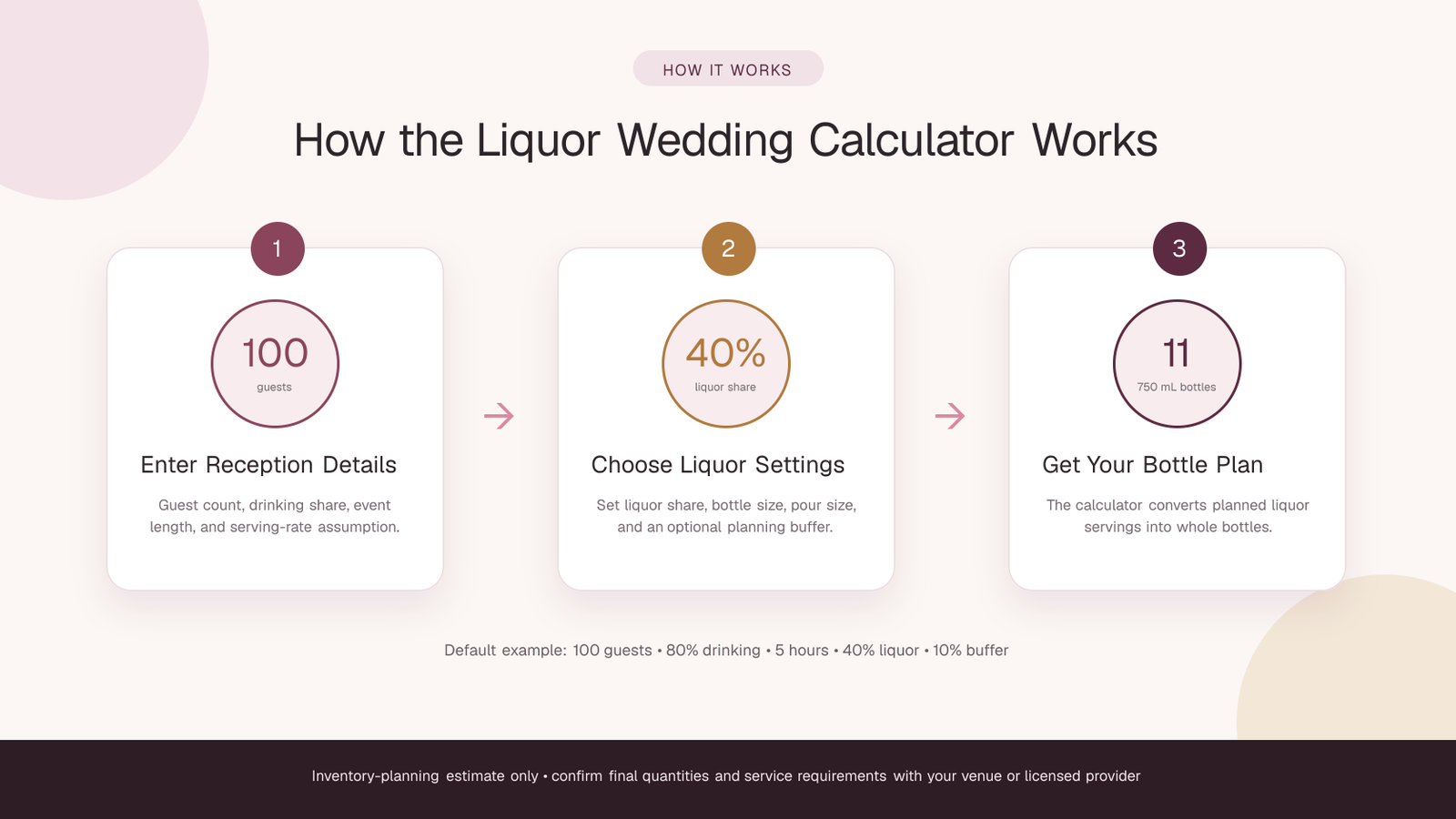
Three-step Liquor Wedding Calculator guide: enter reception details, choose liquor settings, and get a whole-bottle planning estimate. The default example shows 100 guests, 80 percent drinking guests, five hours, 40 percent liquor share, and a 10 percent buffer.

How to Use the Liquor Wedding Calculator

Start with the reception details you already know, then refine the spirits assumptions until they match the event you are actually planning. The calculator is designed to make every major input visible instead of hiding the estimate behind one fixed chart.

01

Enter Reception Details

Add the total guest count, expected drinking guest percentage, reception length, and the average alcoholic-servings-per-hour assumption you want to use for planning.

02

Set the Liquor Plan

Choose the percentage of alcoholic servings expected to be spirits, select the bottle and pour sizes, and add an optional planning buffer.

03

Review the Bottle Estimate

Press Calculate Liquor Bottle Plan to see estimated liquor servings, whole pours per bottle, the number of bottles, and total liquor volume.

Recalculate when the RSVP count, service window, liquor share, bottle size, or pour size changes. Keeping those assumptions current is more useful than relying on one static number from early in the planning process.

Why Use This Liquor Wedding Calculator?

A wedding liquor estimate can change quickly when the guest list, service time, bottle format, or spirits share changes. This tool keeps those variables in one place so you can compare realistic planning scenarios without rebuilding the arithmetic by hand.

Transparent Instead of One-Size-Fits-All

The tool does not assume that every wedding has the same bar. You can change the drinking guest percentage, reception length, liquor share, buffer, bottle size, and planning pour size to match your own event assumptions.

Useful for Different Bottle Formats

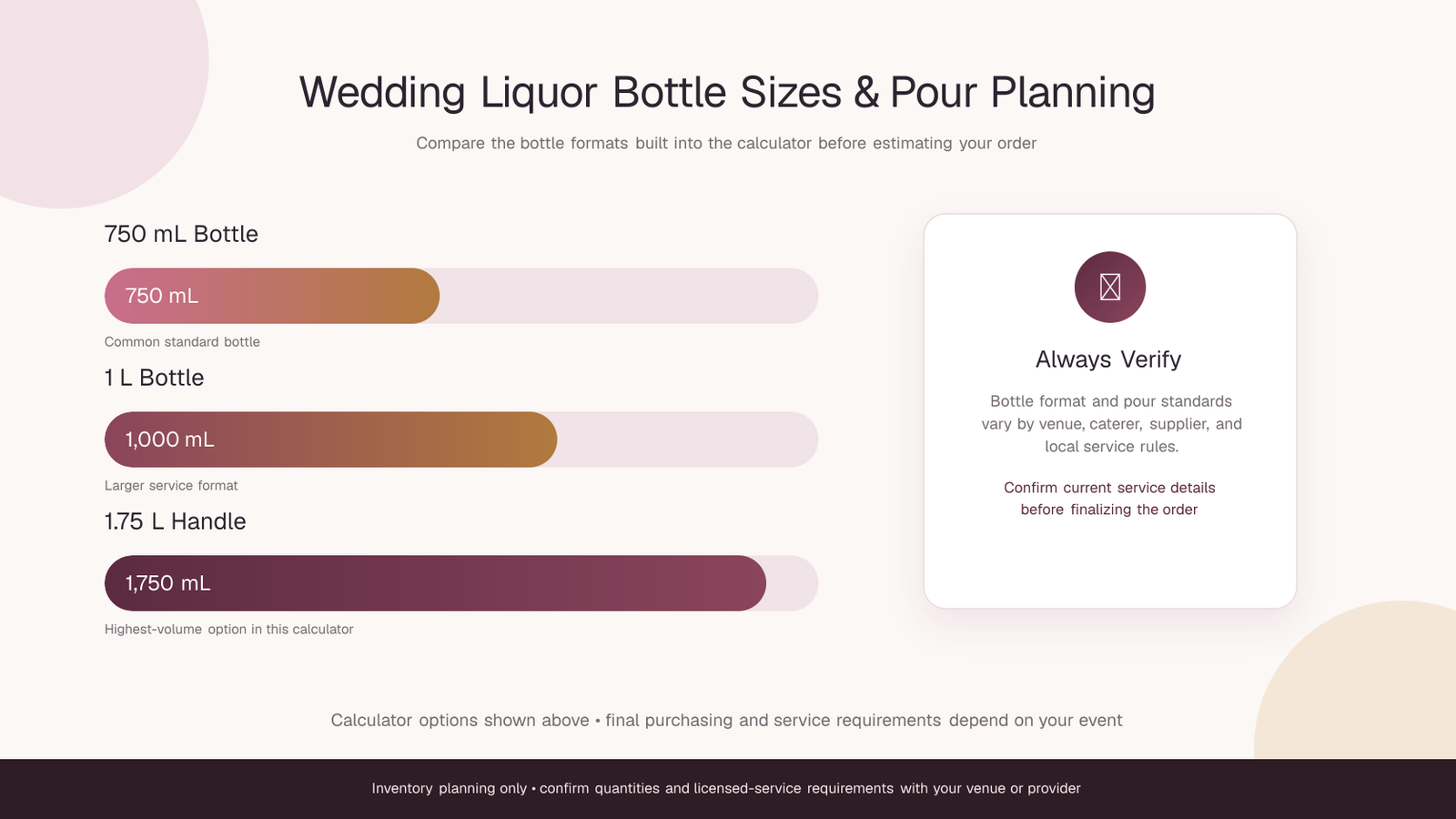
The calculator currently supports 750 mL bottles, 1 L bottles, and 1.75 L handles. Because bottle size affects the number of whole planning pours available, changing the format also changes the number of bottles required.

Adjustable Pour Assumptions

You can plan with 1.0, 1.25, or 1.5 US fl oz pours. The calculator converts the selected pour size into milliliters and uses whole pours per bottle when estimating the purchase quantity.

Built for Scenario Planning

Try a lower or higher liquor share, compare bottle sizes, or update the final RSVP count. The value of the tool is not that one result is universally correct; it is that you can quickly see how a changed assumption affects the bottle estimate.

What Is a Liquor Wedding Calculator?

A Liquor Wedding Calculator is an inventory-planning tool that estimates how many bottles of spirits may be needed for a wedding reception. It first estimates total alcoholic servings from your reception assumptions, then applies the liquor share and converts those planned liquor servings into whole bottles.

This tool focuses specifically on spirits. It does not calculate beer, wine, mixers, water, ice, glassware, staffing, or local alcohol-service requirements. Those items should be planned separately.

Guest assumptionsTotal guests and expected drinking guest percentage.
Service assumptionsReception length and average alcoholic servings per guest per hour.
Liquor assumptionsSpirits share, planning buffer, bottle size, and pour size.
OutputEstimated liquor servings, whole pours per bottle, bottle count, and liters.

What Kind of Wedding Bar Are You Planning?

The liquor percentage should describe the share of your planned alcoholic servings that you expect to come from spirits. The right input depends on the bar format, menu, and guest preferences rather than on a universal wedding rule.

Mixed Beer, Wine & Spirits Bar

Use the liquor-share field to represent the spirits portion of the overall alcoholic serving plan while beer and wine are handled separately.

Spirits-Forward Reception

If cocktails or straight spirits are expected to make up a larger part of the bar, test a higher liquor share and review how the bottle count changes.

Signature-Cocktail Menu

Use the tool for the base spirits portion of the plan, then calculate mixers, garnishes, and cocktail-specific ingredients separately.

Limited-Spirits Bar

If spirits are only a small part of the reception beverage mix, enter a smaller liquor share rather than treating the entire alcohol plan as liquor.

How to Choose a Practical Liquor Plan

A useful estimate is one whose assumptions you can explain to the venue or bar provider. Keep the inputs tied to the reception you are planning and update them when the event changes.

Match the Service Window

Use the period when alcohol will actually be served rather than automatically using the entire wedding-day schedule. A later bar opening or earlier last call changes the planning window.

Use a Realistic Liquor Share

Liquor share is not the percentage of guests who drink. It is the percentage of planned alcoholic servings expected to be spirits. Keep those two inputs separate.

Confirm Bottle and Pour Sizes

A venue may pour differently from the planning assumption or purchase a different bottle format. Matching those values before final ordering makes the output more useful.

7 Tips for Building a Better Wedding Liquor Estimate

These planning checks help keep the calculator result tied to the real reception instead of turning it into a generic bottle count.

  1. Update the guest count after RSVPs.Invited guests and confirmed guests are not the same planning number.
  2. Separate total guests from drinking guests.Use the drinking percentage so the calculator does not treat everyone as an alcohol consumer.
  3. Use the actual alcohol-service duration.Base the hours on the bar-service window whenever possible.
  4. Keep liquor share distinct from beer and wine.This calculator isolates spirits; the other beverage categories need their own quantities.
  5. Match the bottle size you expect to buy.750 mL, 1 L, and 1.75 L bottles produce different whole-pour counts.
  6. Use the venue's pour standard when you have it.The closer the planning pour is to real service, the more useful the bottle estimate becomes.
  7. Confirm the final plan with the professionals serving the event.Venue rules, licensed-service requirements, local law, responsible service, and non-alcoholic options still matter.

The calculator is designed for inventory planning only. It should not be used as a target for guest alcohol consumption.

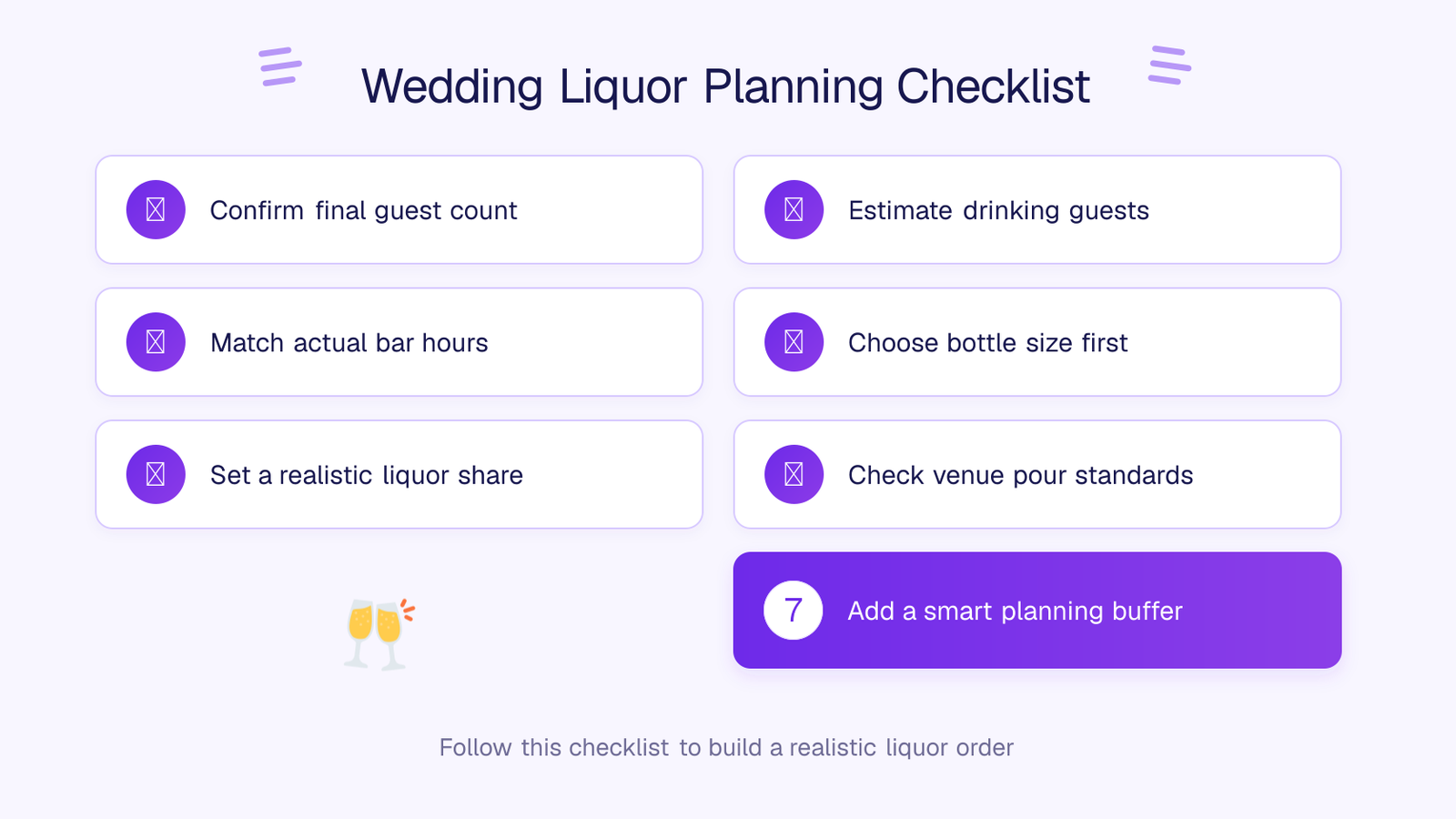
Wedding Liquor Planning Checklist with seven planning checks: confirm final guest count, estimate drinking guests, match actual bar hours, choose bottle size, set a realistic liquor share, check venue pour standards, and add a planning buffer.

Wedding Liquor Planning Checklist — What Each Step Means

A bottle estimate becomes more useful when every input reflects the reception you are actually planning. Use the checklist as a final review before relying on the calculator result or sharing the estimate with your venue or bar provider.

Confirm the Final Guest Count

Use the most current RSVP total rather than the original invitation count. A smaller or larger confirmed guest list changes the entire serving estimate, so update this number whenever your attendance count changes.

Estimate the Drinking Guest Share

Not every guest will drink alcohol. Enter a percentage that reflects your actual guest mix instead of automatically assuming 100%. This keeps non-drinkers separate from the liquor inventory estimate.

Match the Actual Bar-Service Hours

Use the time alcohol will really be served. Cocktail hour, dinner service, last call, or venue restrictions can make the bar window shorter than the full reception.

Choose the Bottle Size Before You Calculate

A 750 mL bottle, 1 L bottle, and 1.75 L handle contain different amounts of liquor. Select the bottle format your venue or supplier expects to use so the whole-bottle estimate matches the purchasing format.

Set a Realistic Liquor Share

Liquor share means the portion of all planned alcoholic servings expected to come from spirits. If beer and wine make up most of the bar, use a lower spirits share. If cocktails dominate the menu, test a higher spirits share.

Check the Venue Pour Standard

The calculator supports 1.0, 1.25, and 1.5 US fl oz planning pours. Use the option closest to the venue's real service standard when you know it, because pour size directly affects how many whole servings fit in each bottle.

Add a Sensible Planning Buffer

A small buffer can help account for ordinary planning uncertainty, but it should not be treated as a consumption target. Keep the buffer tied to inventory risk, venue policy, and the professional advice of the people serving the event.

After reviewing all seven items, recalculate once more using the final settings. The output is still an inventory-planning estimate, so confirm the final order with your venue, caterer, bartender, or licensed alcohol-service provider.

Wedding Liquor Planning Scenarios by Bar Style

Different receptions can use the same calculator in very different ways. Instead of copying one universal bottle rule, start with the bar style and adjust the calculator inputs to match it.

MIXED BAR

Beer, Wine & Spirits

Use a moderate liquor share and plan beer and wine separately so the spirits estimate represents only its part of the beverage mix.

COCKTAIL-LED

Signature Cocktail Reception

Use the liquor calculator for base spirits, then calculate mixers, syrups, garnishes, and cocktail-specific ingredients separately.

LIMITED SPIRITS

Wine & Beer First

Enter a smaller liquor share when spirits are available but are not expected to be the main alcoholic option.

SPIRITS-HEAVY

Full Cocktail Bar

Test a higher spirits share, then confirm bottle format, pour standard, service duration, and responsible-service requirements with the venue.

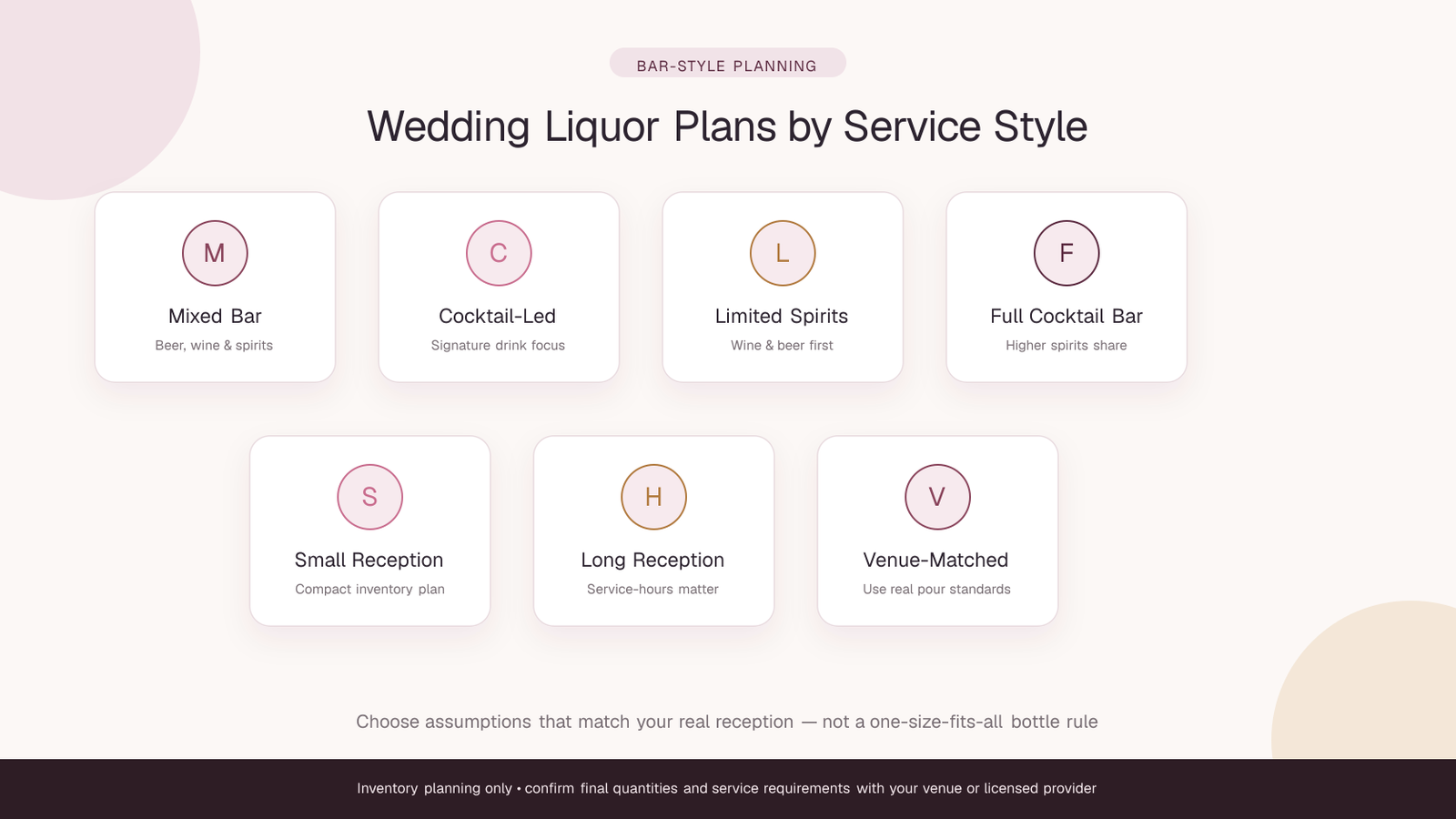
Seven wedding liquor planning styles: mixed bar, cocktail-led, limited spirits, full cocktail bar, small reception, long reception, and venue-matched planning.

Wedding Bar Styles and What They Mean for the Calculator

The bar style does not automatically decide your bottle count. It helps you choose a more sensible liquor-share assumption and identify which other beverage categories need to be planned separately.

Mixed Bar

Beer, wine, and spirits all share the beverage plan. Use the liquor-share field only for the spirits portion, then estimate beer and wine separately.

Cocktail-Led

Signature drinks or mixed cocktails are a major part of service. The calculator can estimate base-spirit bottles, while mixers, syrups, garnishes, and non-alcoholic components still need their own plan.

Limited Spirits

Spirits are available but are not expected to make up most alcoholic servings. A lower liquor-share assumption is usually more consistent with this setup than treating the whole bar as liquor.

Full Cocktail Bar

Spirits play a larger role in the beverage mix. Test a higher liquor share, then confirm the final service assumptions with the venue or licensed bar provider.

Small Reception

Smaller guest counts make rounding more noticeable because the calculator purchases in whole bottles. Check the final output against supplier case sizes and venue policies before ordering.

Long Reception

A longer alcohol-service window increases the planning estimate when the serving-rate assumption stays the same. Use the actual bar-service duration rather than the full wedding-day timeline.

Venue-Matched Plan

Use the venue's real bottle format, pour standard, bar hours, and service rules whenever those details are available. Matching the calculator to the actual service setup makes the estimate easier to review with professionals.

Planning StyleCalculator Focus
Mixed barSet liquor as only one share of the total alcohol plan.
Cocktail-ledEstimate base spirits; plan mixers and garnishes separately.
Limited spiritsUse a smaller liquor-share assumption.
Full cocktail barTest a larger spirits share and verify venue service details.
Small receptionWatch whole-bottle rounding and supplier packaging.
Long receptionUse the real alcohol-service window in hours.
Venue-matchedUse the venue's bottle and pour standards where known.

Liquor Wedding Calculator Guide

This guide explains the settings inside the calculator and how each one changes the inventory estimate.

Guest and Drinking-Guest Inputs

Total guests sets the size of the event. Drinking guest percentage prevents the calculator from treating every attendee as an alcohol consumer.

Reception Length and Serving Rate

These inputs create the base alcoholic-serving estimate. Use the actual service window and a planning assumption that your venue or bar professional considers appropriate for the event.

Liquor Share

Liquor share is the percentage of planned alcoholic servings expected to be spirits. It is separate from the percentage of guests who drink.

Bottle and Pour Settings

Choose 750 mL, 1 L, or 1.75 L bottles and a 1.0, 1.25, or 1.5 US fl oz planning pour. The calculator uses whole pours per bottle before rounding the purchase quantity up.

Planning Buffer

The buffer is an inventory-planning adjustment for uncertainty. It should not be interpreted as a target for guest consumption.

Pro Tip

Re-run the calculator after final RSVPs and again after confirming the venue's pour size, bottle format, bar hours, and any restrictions on outside alcohol.

Wedding Liquor Planning Conventions Across Venues

Venues and bar services do not all operate the same way. Before placing an order, confirm the rules that affect purchasing, serving, storage, and returns.

What Common Planning Details Usually Depend On

Planning DetailUsually Depends On
Bottle formatVenue, caterer, distributor, or supplier inventory.
Pour sizeVenue policy, bartender standard, and drink style.
Bar-service hoursReception schedule, last call, venue rules, and local law.
Outside alcoholVenue contract, licensing, corkage, and local regulations.
Unopened-bottle returnsRetailer or distributor return policy.
Licensed serviceVenue requirements and applicable local alcohol laws.

The calculator can estimate inventory from your inputs, but it cannot determine your venue contract or local legal requirements. Verify those details directly with the responsible provider.

How Many Liquor Bottles Can a Wedding Reception Need?

There is no single bottle count that works for every wedding. The result depends on the confirmed guest count, drinking guest share, bar-service hours, serving-rate assumption, liquor share, bottle size, pour size, and planning buffer.

Use the calculator to model those variables together, then treat the output as an inventory estimate for discussion with your venue, caterer, bartender, or licensed alcohol-service provider. Final ordering should also account for supplier packaging, return policies, non-alcoholic choices, and responsible-service requirements.

Wedding liquor bottle size comparison showing the calculator's 750 milliliter, 1 liter, and 1.75 liter bottle options, with a reminder to verify venue pour and service standards before finalizing an order.

Liquor Wedding Planning Rules to Confirm Before Ordering

The calculator can estimate bottle quantities, but the final order still depends on practical details outside the calculation. Check these items with your venue, caterer, bartender, retailer, or licensed alcohol-service provider before you buy.

Planning FactorCalculator OptionsWhat to ConfirmWhy It Matters
Bottle format750 mL, 1 L, 1.75 LWhich sizes your venue or supplier will actually use.Different bottle volumes change the number of whole pours per bottle.
Pour size1.0, 1.25, 1.5 US fl ozThe venue's normal measured pour for the drinks being served.A larger pour reduces the number of servings available from each bottle.
Service windowUser-entered reception hoursWhen alcohol service really begins and ends.The service duration is part of the calculator's base serving estimate.
Outside alcoholNot determined by the calculatorWhether outside alcohol is permitted and what fees or restrictions apply.Venue contracts and local requirements can affect where alcohol is purchased or served.
ReturnsNot determined by the calculatorWhether unopened bottles can be returned and under what conditions.Return policy can affect how you think about a reasonable inventory buffer.
Licensed serviceNot determined by the calculatorWho is legally and contractually allowed to serve alcohol at the event.Service requirements depend on the venue and applicable local rules.

Venue & Supplier Rules: Check Before You Finalize the Order

A calculator result is only one part of the purchasing decision. Some venues require alcohol to be bought through an approved caterer or bar provider, some allow outside alcohol under specific contract terms, and suppliers may have their own case sizes or return rules.

Before you commit to the final bottle count, verify the bottle sizes available, the service pour, actual bar hours, storage or delivery requirements, unopened-bottle return policy, and any licensing or service conditions that apply to your event.

The calculator does not determine legal requirements or venue policy. Those details must be confirmed directly with the responsible venue, supplier, or licensed provider.

Wedding Liquor Do's and Don'ts

Use the estimate as a planning aid, then combine it with the real service conditions of your reception. A good bottle plan is transparent, adjustable, and easy to review with the professionals handling the bar.

DO

Keep Your Inputs Current

Update the guest count after RSVPs, use the real bar-service window, and match the bottle and pour settings to the venue whenever those details are available.

DON'T

Treat the Estimate as a Consumption Target

The output is for inventory planning. It should never be interpreted as how much guests are expected or encouraged to drink.

DO

Plan Non-Alcoholic Choices Too

Water and appealing non-alcoholic drinks are a separate part of the event beverage plan and should be available regardless of the liquor estimate.

DON'T

Assume Every Venue Uses the Same Rules

Bottle sourcing, pour standards, bar hours, outside-alcohol policies, and licensed service requirements can differ from one venue to another.

DO

Check the Return Policy Before Adding a Buffer

If unopened bottles can be returned, that may affect how you approach inventory uncertainty. Confirm the exact supplier policy first.

DON'T

Mix Up Liquor Share and Drinking-Guest Percentage

Drinking guest percentage estimates how many guests may drink alcohol. Liquor share estimates what portion of alcoholic servings may be spirits. They are different inputs.

Frequently Asked Questions

Clear answers about guest counts, liquor share, bottle sizes, pour assumptions, buffers, venue rules, and how to use the estimate responsibly.

What does a Liquor Wedding Calculator actually calculate?

It estimates the number of liquor bottles that may be needed for a wedding reception. The tool uses your guest count, expected drinking guest percentage, bar-service hours, average alcoholic-servings-per-hour assumption, liquor share, planning buffer, bottle size, and pour size to build the estimate.

How many liquor bottles do I need for a wedding?

There is no single bottle count that fits every wedding. The result changes with the number of guests, how many are expected to drink, the service window, the share of alcoholic servings expected to be spirits, and the bottle and pour sizes. Enter those details into the calculator to create an event-specific inventory estimate.

What does drinking guest percentage mean?

It is the percentage of your total guest list that you expect may drink alcohol. It is separate from liquor share. For example, 80% drinking guests means the calculator uses 80% of the guest count when building the base alcoholic-serving estimate.

What does liquor share mean in this calculator?

Liquor share is the percentage of planned alcoholic servings expected to come from spirits rather than beer, wine, or other alcoholic categories. It does not mean the percentage of guests who drink.

Which bottle sizes can I use?

The calculator currently supports 750 mL bottles, 1 L bottles, and 1.75 L handles. Choose the format closest to what your venue, caterer, or supplier expects to purchase.

Which pour sizes can I select?

You can plan with 1.0, 1.25, or 1.5 US fl oz pours. The selected pour size affects how many whole pours fit in each bottle, so use the venue's real service standard when you know it.

What is the planning buffer for?

The buffer is an optional inventory-planning adjustment for uncertainty. It is applied to the estimated alcoholic-serving total before the liquor share is calculated. It should not be interpreted as a target for guest alcohol consumption.

Does this calculator include beer and wine too?

No. This page focuses on liquor or spirits. Beer, wine, mixers, water, non-alcoholic drinks, ice, garnishes, glassware, and staffing should be planned separately.

Should I use the full wedding-day length as the reception hours?

Usually, you should use the period when alcohol will actually be served rather than the entire wedding-day schedule. Cocktail hour, dinner, last call, and venue restrictions can make the bar-service window shorter than the full event.

What if some guests do not drink alcohol?

Lower the drinking guest percentage so the calculator does not treat every attendee as an alcohol consumer. This is one reason the tool keeps total guests and drinking guests as separate inputs.

Can I use this for a cocktail-focused wedding?

Yes. For a cocktail-led reception, use the liquor-share setting to represent the spirits portion of the alcoholic beverage plan. Then calculate mixers, syrups, garnishes, and non-alcoholic cocktail ingredients separately.

Is the bottle estimate exact?

No. It is an inventory-planning estimate based on the assumptions you enter. Real needs can vary with guest preferences, service style, measured pours, menu choices, venue policies, supplier packaging, and the actual duration of alcohol service.

Why should I confirm the result with my venue or bartender?

Venues and bar providers may use different bottle formats, pour standards, bar hours, sourcing rules, return policies, licensing requirements, and responsible-service practices. The calculator cannot determine those event-specific rules for you.

Can unopened liquor bottles be returned after the wedding?

That depends on the retailer, distributor, local rules, and the condition of the bottles. Check the supplier's current return policy before using returnability as part of your planning buffer.

Can I bring my own liquor to the venue?

It depends on your venue contract and applicable local requirements. Some venues allow outside alcohol under specific conditions, while others require purchasing through an approved caterer or bar provider. Confirm this directly with the venue before buying.

When should I run the calculator again?

Recalculate after final RSVPs and whenever the bar-service hours, liquor share, bottle size, pour size, or venue rules change. Updating the assumptions near the event date gives you a more useful planning estimate.