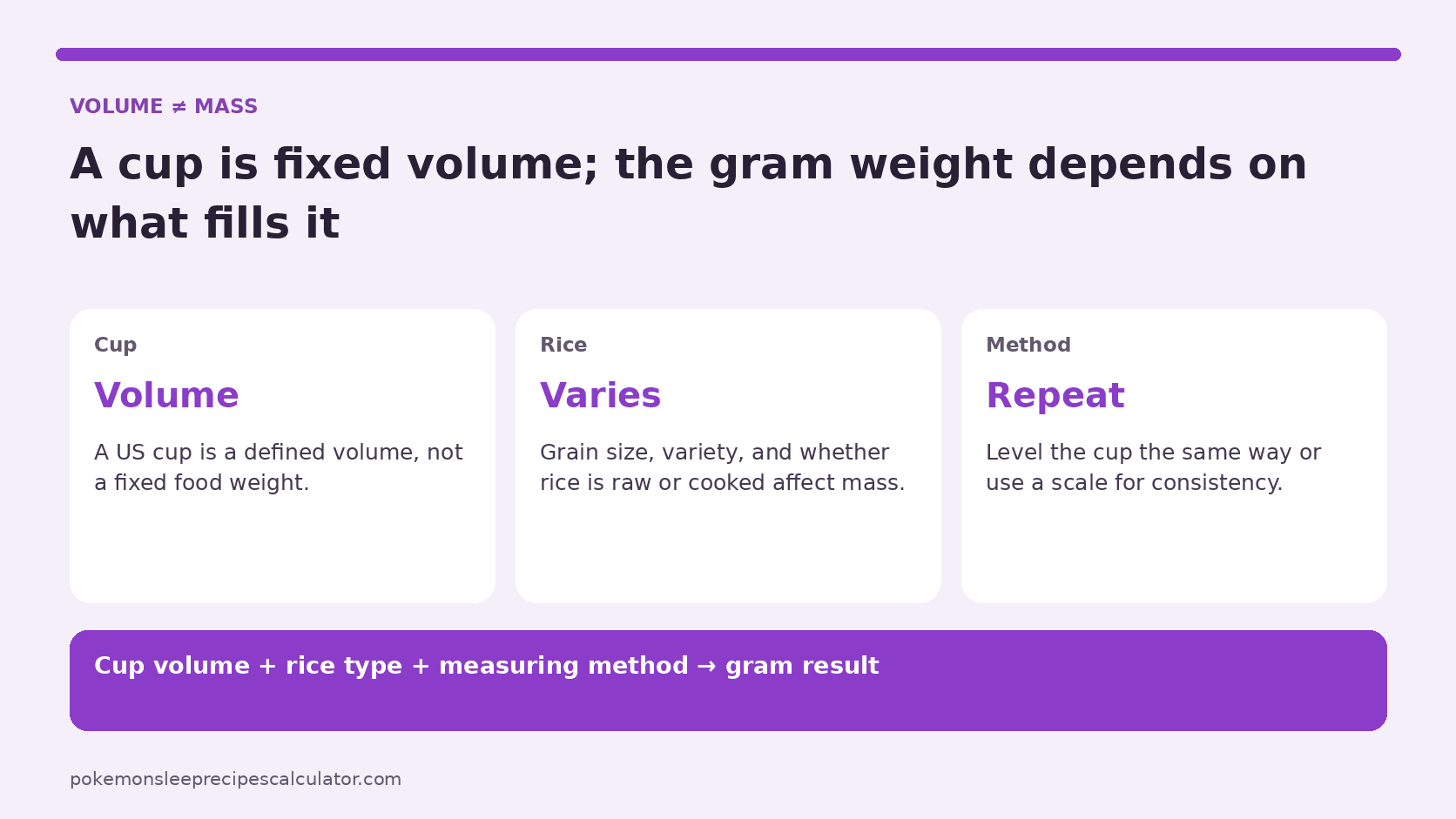
The key idea: cups and grams measure different things
A cup measures volume. A gram measures mass. Converting a cup of an ingredient to grams therefore depends on how much mass that ingredient packs into the cup's volume.
NIST defines a US cup as 236.5882 mL in its SI conversion tables. That fixes the volume, but it does not make every cup of food weigh the same. A cup of rice, flour, sugar, and water can all fill the same volume while having different masses.
Rice type changes how densely the cup fills
Long-grain, medium-grain, short-grain, basmati, jasmine, brown, and other rice types differ in grain dimensions and surface characteristics. Those differences change how much empty space remains between grains in a measuring cup.
That is why a single internet number for '1 cup rice in grams' should not be treated as a universal physical constant. A useful converter should identify the rice condition and explain the assumption behind the result. The rice cup-to-grams calculator lets you select the rice condition and cup standard.
Raw rice and cooked rice are not interchangeable
Cooking changes rice dramatically because the grains absorb water. A cup of cooked rice therefore represents a different material state from a cup of dry rice. Even when the cup volume is the same, the mass and nutritional meaning can differ.
Before converting, check whether the recipe is asking for uncooked rice to go into the pot or a measured cup of already cooked rice. Mixing those two states can change both the recipe yield and the amount of water needed.
How you fill the cup affects repeatability
Scooping, pouring, shaking, pressing, or heaping can change how much rice fits into a cup. For dry grains, a repeatable method is more important than trying to chase an unrealistic level of decimal precision.
Use the same cup, fill it without deliberately compressing the grains, and level the top. If the recipe is sensitive to small differences, weigh the rice directly on a kitchen scale instead of relying on a volume-to-mass estimate.
Why a scale is better for scaling recipes
When doubling or tripling a rice recipe, small cup-measurement differences can multiply. A digital scale avoids the packing variation that comes with repeated scoops and makes it easier to reproduce the same batch later.
A cup-to-grams tool is still useful when a recipe gives only cups and you want a practical estimate. The best use is to choose the correct rice type or assumption, convert once, and then weigh that amount consistently for future batches.
Use package information when it is more specific
Food labels often pair a household serving measure with a gram amount. If the package for your exact rice gives a cup fraction and gram weight, that product-specific information can be more useful than a generic chart because it reflects the manufacturer's own serving declaration.
USDA guidance on serving-size statements illustrates the broader principle: household measures and gram equivalents can appear together. For cooking accuracy, prefer the information that most closely matches the product and state of the rice you are actually using.
A reliable way to convert one cup of rice
First identify whether the rice is dry or cooked. Next identify the variety when the tool provides a specific option. Use a level cup rather than a compressed or heaped one, and treat the result as an estimate unless you are using a product-specific weight.
For repeat cooking, place an empty bowl on a scale, tare it to zero, and weigh the converted amount. Save that gram value with your recipe. That gives you a consistent method even if your measuring cups change later.