Start with what is cookable, not what looks strongest on paper
A useful recipe plan begins with constraints. In Pokémon Sleep, a recipe only matters if it belongs to the current dish category, fits the cooking pot, and can be supplied by ingredients you can reasonably gather before the next meal. Looking only at a recipe's final strength can make a theoretically attractive choice impractical. Use the Pokémon Sleep recipe calculator to compare your available ingredients with recipe requirements.
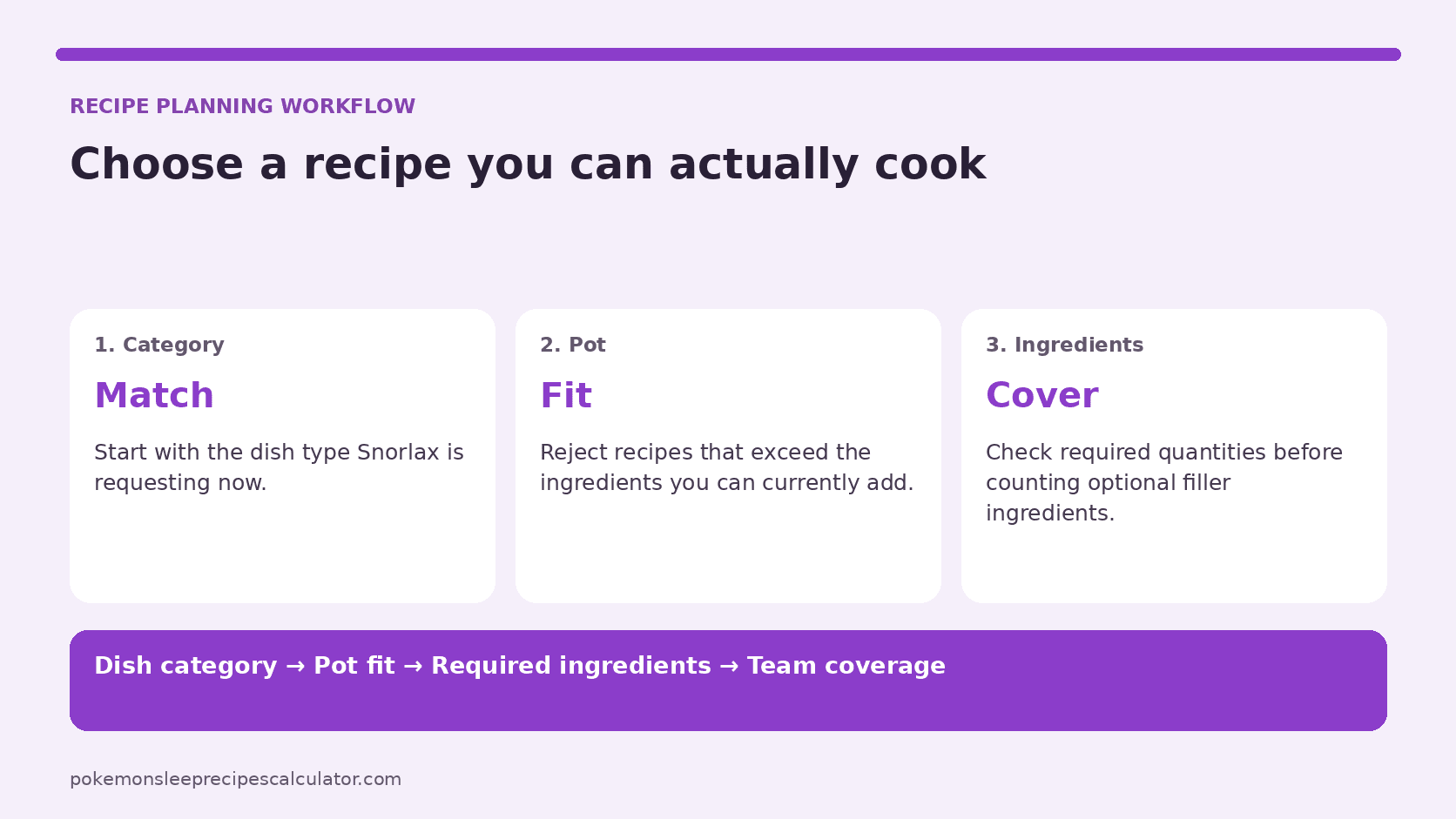
A cleaner workflow is to narrow the recipe list in stages. First identify the current dish category. Next remove recipes that do not fit your present pot capacity. Then compare the remaining ingredient requirements against what your helper team is likely to bring. This turns recipe selection into a short planning problem instead of a long list of possibilities.
Check the current dish category before doing any ingredient math
Pokémon Sleep rotates among Curries/Stews, Salads, and Desserts/Drinks, and special events can lock the requested category for the event period. That means a saved ingredient plan can become irrelevant when the category changes.
For example, the official Summer Festival 2026 notice set dishes to Curries/Stews for the event, while Spring Festival 2026 centered on Salads. These are event-specific conditions, not permanent rules. When planning around an event, use the event notice for that date rather than assuming the previous week's category still applies.
Treat pot capacity as a hard filter
If a recipe requires more ingredients than your current pot can hold, it is not a valid immediate option. This sounds obvious, but it is easy to overlook when comparing high-requirement recipes with smaller dishes.
Pot capacity can also change during events. Some cooking events temporarily increase the number of ingredients that fit in the pot. Because those bonuses can differ from one event to another, the safest approach is to enter the capacity that is actually available to you now instead of building a plan around a historical event bonus.
- Use your current pot capacity, not the largest capacity you have ever seen during an event.
- Check whether an event changes capacity on all days or only on specific days.
- Re-run the recipe filter after a pot upgrade or event reset.
Separate required ingredients from filler ingredients
The required ingredient list determines whether the game recognizes a specific recipe. Extra ingredients can increase the total value of a cooked dish, but they do not replace missing required ingredients.
For planning, track required quantities first. If a recipe needs several ingredient types, compare those quantities with your current inventory and your team's ingredient coverage. Only after the required set is secure should you decide whether spare ingredients are worth adding as filler.
This ordering reduces waste. It also makes shortages visible early. A recipe that is short by one key ingredient may be less practical than a slightly smaller recipe whose full requirement is already covered.
Build ingredient coverage across the whole team
A team does not need one helper dedicated to every recipe. What matters is whether the combined ingredient output gives you a realistic path to the quantities you need across several meal windows.
Look for overlap. A helper that supplies an ingredient used in several useful recipes can be more flexible than one whose ingredient is only relevant to a single target. Ingredient-focused helpers, inventory, nature, sub skills, and main skills can all affect practical supply, so the calculator should be used alongside your actual roster rather than as a substitute for it.
Recheck event rules before committing rare ingredients
Cooking events can change pot size, dish-strength multipliers, ingredient-related main-skill effects, and ingredient gathering. Those changes can alter which recipe is the sensible target for a particular week.
The official Packed Portions Cooking Week notices are a good example of why dates matter: the event bonuses were not identical between Part 1 and Part 2. A guide that copies one event's multipliers into a permanent strategy page will eventually be wrong.
Before spending a scarce ingredient stockpile, confirm the current event notice, then run the recipe calculation using today's category and pot capacity. That small check keeps the plan tied to the game state you actually have.
A repeatable five-minute recipe planning routine
Before a meal, note your requested category, current pot capacity, and the ingredients already in the bag. Use the calculator to narrow the list to recipes that fit those constraints. Pick one primary recipe and one lower-cost fallback that shares some of the same ingredients.
Then compare the shortages for those two recipes with your helper team. If the primary target needs a rare ingredient you are unlikely to replace before the next meal, consider preserving it and using the fallback instead. The best plan is not always the recipe with the largest theoretical number; it is the one that balances current strength, repeatability, and your next few meals.